I’ve been bitten by the Astrophotography bug. My last post was about my very first attempt at Astrophotography when I had a chance to go out to West Texas. Now I’ve had a chance to do some more in Colorado, with a business trip to Denver. The fun thing is that it doesn’t interfere with my day job and this time I knew I wouldn’t have to be out really late. So just for fun I decided to rent a different camera. I thought I’d try the Fuji X-T10, the latest from them. I’m going to write about my overall impressions of this camera in a later post, but my plan was to use it with my Rokinon 12mm or my Fuji 16mm. I was also curious about how my Fuji x100s would perform, with or without the WCL-X100 wide angle adapter. Ian at Lonelyspeck.com has recently been saying that you don’t need a superfast lens to do astro work, so I wanted to put my all time favourite camera to the test. It has a native f2.0 lens, which because the wide angle converter mounts on the front, remains at f2.0.
This post contains references to products from one or more of my advertisers.
I may receive compensation when you click on links to those products.
I don’t own an X-T10 but I’d like to try the latest and greatest. I rented it from Borrowlenses.com (note: I may get paid if you click from here and then decide to rent). A summer special of $25 off a rental made it a no brainer. I don’t have a custom bracket for it, so used a generic Arca-Swiss plate to assist with mounting on the tripod. The X-T10 has a traditional screw thread remote release socket on the shutter button, which is perfect for me. I was interested in some of the bells and whistles of the new camera, so got one headed to me. As far as the lenses went, from my previous work I know that the 12mm Rokinon is superb. The 16mm, while faster, has more Comatic distortion and the 18mm, while my favourite lens, is getting a bit long for what I wanted to achieve. I used the same tools as before to find a dark place in the Rockies above Denver. I decided to go to Mount Evans, as it was within easy reach of where I was staying. While not the darkest sky you can find, the high elevation helps and I was hoping to have a clear enough sky. I was checking forecasts, which didn’t seem too promising, but I know mountain weather can be a bit unpredictable and without blanket overcast in the forecast, I decided to chance it. I headed out at 10 p.m., getting to Summit Lake at around 11:30 p.m. The sky was fairly clear, with the Milky Way nicely visible above the southern horizon. Not fully up, but good enough to try for some interesting mountain shots. What I didn’t take into account was the fact it was cold! I’d flown from Houston (100+ f / 38+ c) to Denver (85 f / 30 c). Driving up to Summit Lake (45 f / 7 c) dressed for Houston. No jacket. Tough to concentrate while shivering! Another lesson learned by the school of experience.
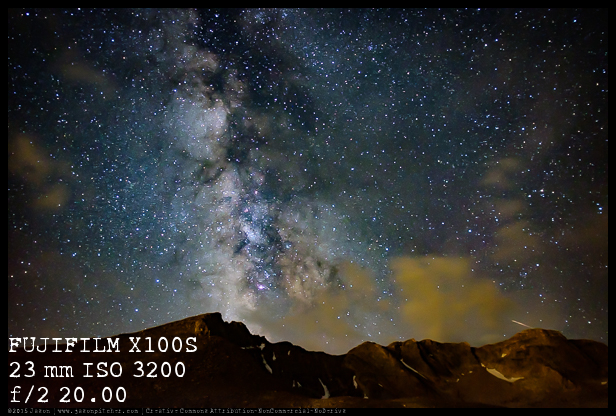
First Up, The X100s with native lens
(Rent from Borrowlenses.com) (Buy from Amazon.com X100T latest model)
I know I should have been better prepared. The settings for the camera and lens call for a minimum shutter speed of 16 seconds at 6400 ISO. So I went with 20 seconds at 3200 iso. Underexposed (again) by 1-2 stops. Focusing was tough, as usual, but I’m getting better.
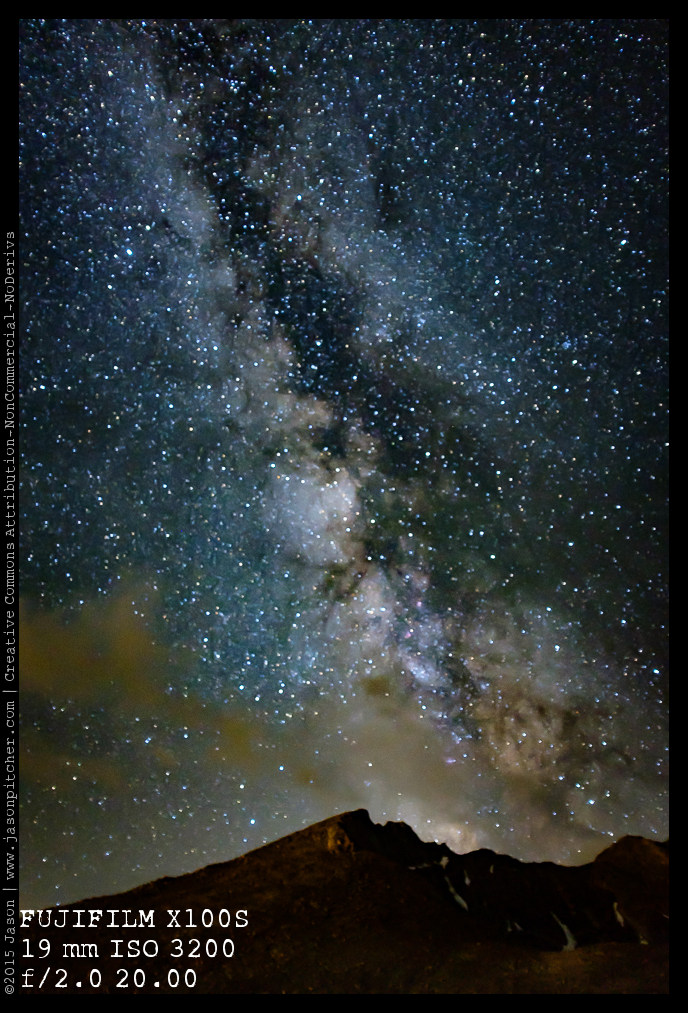
X100s with WCL-X100
(Rent from Borrowlenses.com) (Buy from Amazon.com)
Screwed the WCL on and took some shots. Unfortunately, either I missed focus (more than likely), or the WCL makes is a bit softer. I’m going to have to try this again.
X-T10 with Rokinon 12mm f2.0
(Rent the camera from Borrowlenses.com) (Buy the camera from Amazon.com) (Buy the lens from Amazon.com)
Much closer in terms of exposure. Still underexposed, but I used the right shutter speed and ISO. The X-T10 is easier to use because of the flip screen. Focusing is harder because the dark screen shows a lot of noise. I think I missed it.
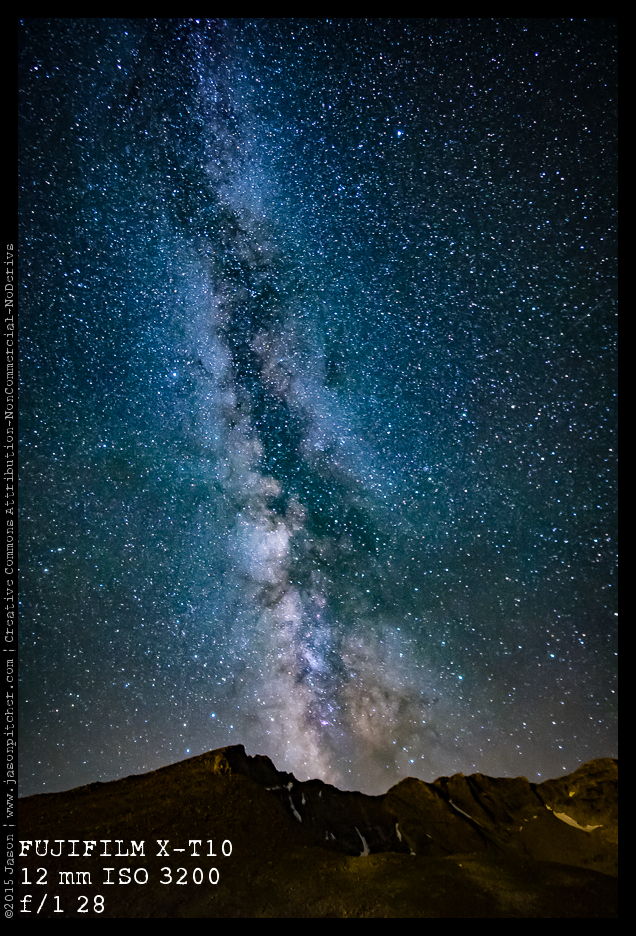
The X-T10 is a perfectly capable machine for Astro work. The only problem I had was the amount of noise on the screen when trying to focus. There is probably a setting I missed to mitigate that, but it makes focusing much harder. This is countered by the fact the screen flips out, which makes life much easier. A proper L-Bracket would go a long way towards helping me like this camera, but to be honest, I’d rather have an x100s/t. My X-Pro1, which I had along for the ride, but didn’t use, is just as capable, even if in a bigger package. I really like the result from the x100s. This little camera just keeps constantly surpassing my expectations. It is surprisingly capable for astrophotography, if you can live with the limited field of view. You can get good results from the wcl-x100 (I think) if you are more careful that I was. I’m going to have to do some more testing to figure out if the WCL is inherently soft, or more likely, user error in this case. If you are comfortable stitching images together and you have an x100s/t, you are going to be happy with the results. It’s a fantastic camera that just continues to show its credentials as a serious imaging machine. For the future, there are rumours of an X-Pro2 with a new Sony sensor that has amazing low light performance. If Fuji put their spin on it and package it as well as their other cameras, I suspect it’ll be a step change above what these cameras can do today. Remember, doing Astro work like this was impossible with film, or early digital cameras. We are able to achieve amazing results with little effort that was just unobtainable a few years ago. That’s cool. More to come…