I’ve been wanting to try my hand at Astrophotography for ages. One small barrier is that I live in Houston, Texas and light pollution in Southeast Texas is, errr, prolific. A look at the map of light pollution shows that to get anything approaching a dark sky you have to head west - a long way west. So when I knew I had a business trip to San Antonio coming up, with several days there and a modicum of free time, I started planning. Using the extremely good advice from Ian Norman at Lonely Speck, I checked weather and viewing condition forecasts and made a plan to head out of San Antonio on I-10, then drive into the hills to the west. I hunted on google for suitable places, but there isn’t much documented out there, so I wasn’t going to get something interesting in the foreground like some photographers manage. I didn’t mind, this was a learning trip for me. I left San Antonio, headed out to a speck on the map called Garven Store, the headed south on highway 83. At around 00:30, I stopped at a roadcut where I could be safely off the road, and admired the beautiful night sky.
This post contains references to products from one or more of my advertisers.
I may receive compensation when you click on links to those products.
For this exercise, I was shooting with my X-Pro1 and I was keen to try a variety of lenses to see what worked for me. As a result, because I was experimenting and learning, I have similar shots taken with a variety of lenses, all primes and some highly rated for this specific purpose. Click on the image to see the full size post processed images. First one on is the Rokinon f2.0. Following Ian’s excellent tutorial, I set up and started shooting. Manual focus is a bit trickier than I thought when you are looking at a black screen and I rapidly found out that I couldn’t access the exposure calculator on the website - no cell service. Duh! I did remember the settings for the Fuji 16mm, so I guessed for the 12mm. And I guessed wrong. Of the images shown here, this one needed the most postprocessing and adjustment. Pure user error. Click on the image to see the full size rendition (opens in a new window).
Rokinon 12mm f2.0***(Buy from amazon.com)***
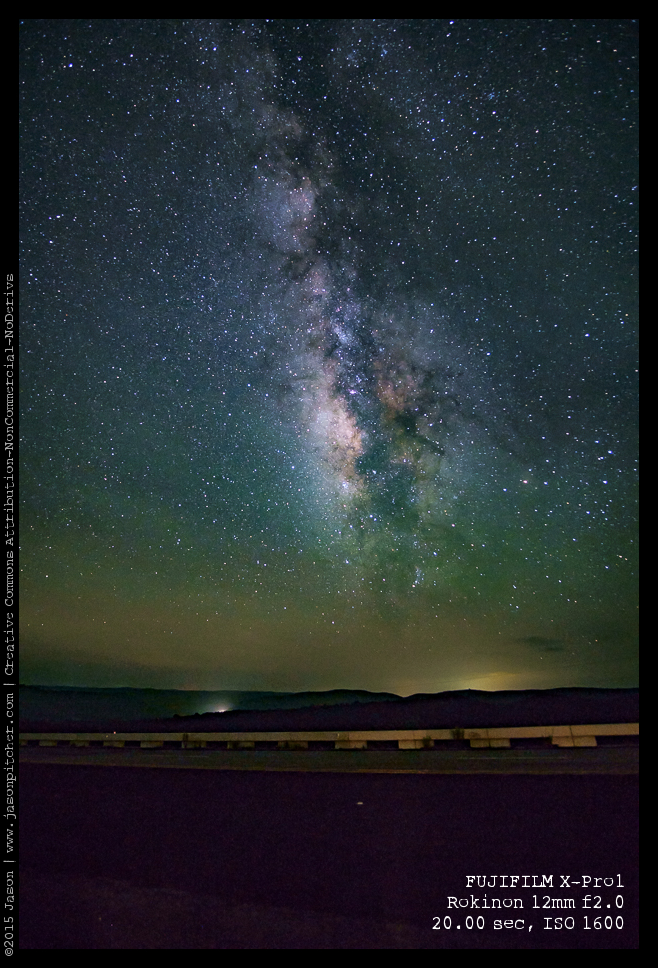 The correct settings for this lens should have been about 28 seconds at 3200 ISO, and I underexposed by at least 2 1/2 stops, so this is way noisier than necessary.
The sky isn’t perfectly clear, with haze and light pollution causing problems down by the horizon, but it’s usable.
The correct settings for this lens should have been about 28 seconds at 3200 ISO, and I underexposed by at least 2 1/2 stops, so this is way noisier than necessary.
The sky isn’t perfectly clear, with haze and light pollution causing problems down by the horizon, but it’s usable.
Fuji 16mm f1.4 (Rent from Borrowlenses.com) (Buy from Amazon.com)
I’d been itching to try this lens out for this purpose. In theory, it should be superb, wide and fast. In practice it is, although it does show some astigmatism in the corners. This makes the stars out there look like Jupiter with rings - very annoying. If you don’t pixel peep it’s not horrible, but once I noticed, there is no going back.
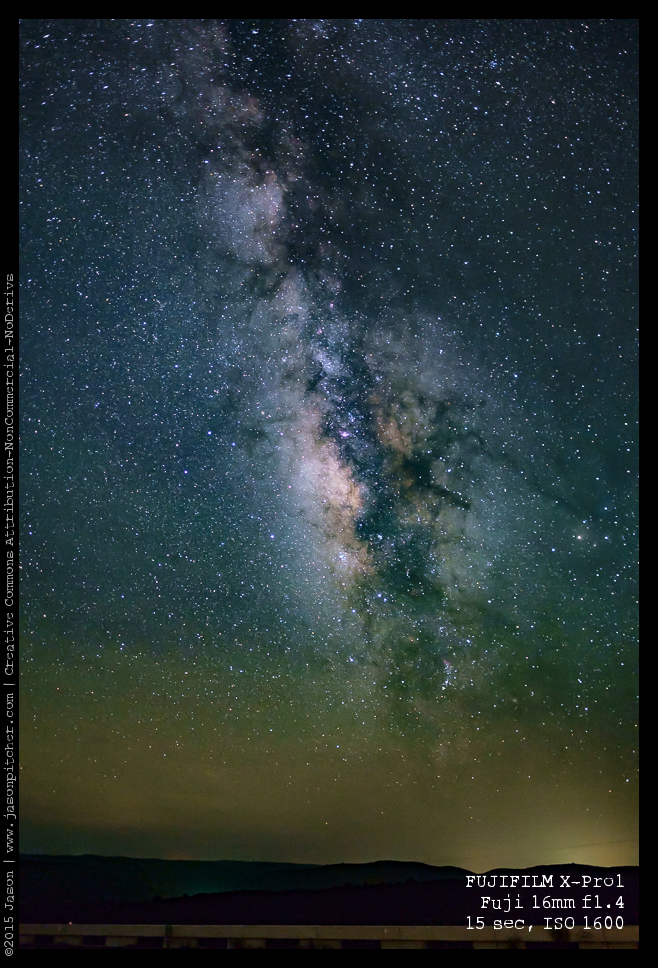 Because the sky isn’t completely clear, the image was underexposed by about 1 1/2 stops. Recoverable, but not perfect. At the calculators recommended shutter speed of 21 seconds, I struggled to get the cleanest image, so I sacrificed noise for speed. Not sure that was the best move.
Fuji 18mm f2.0 (Rent from Borrowlenses) (Buy from Amazon)
I got this lens thrown in when I bought my 56mm off Craigslist. Stealthy little lens is surprisingly good! It doesn’t exhibit the corner astigmatism of the 16mm and has a nice field of view. For those on a budget, this little gem is an outstanding performer and is probably my most used lens due to it’s flexibility. Works really well for astrophotography as well.
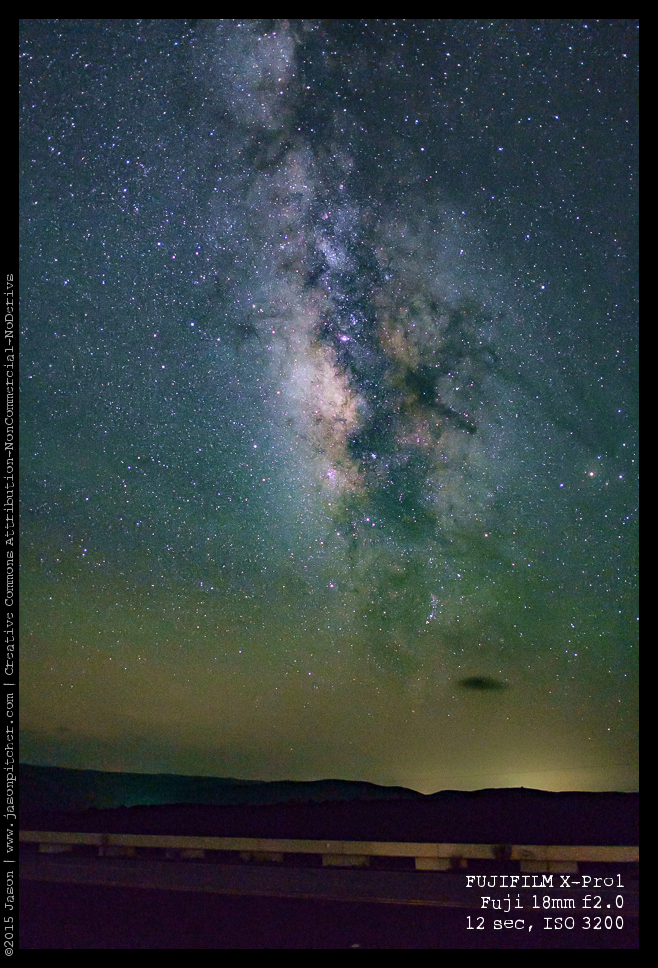 Again, underexposed. I’ve lifted it 1 1/2 stops again, but it could probably have been better with another stop or so exposure.
Fuji 23mm f1.4 (Rent from Borrowlenses) (Buy from Amazon)
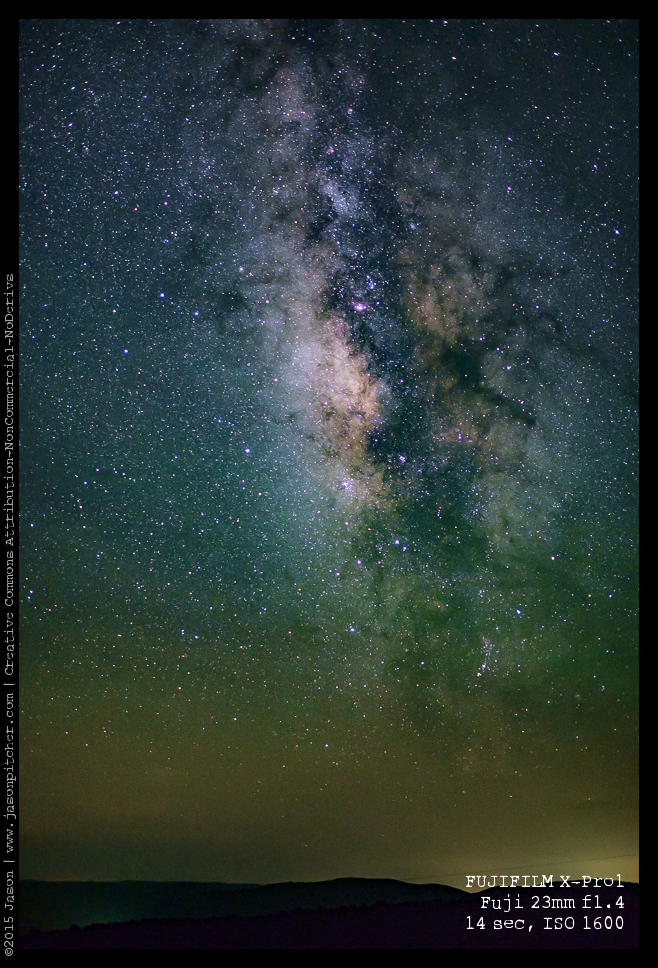
Now we’re into the longer focal lengths. This is again underexposed by 2 stops, and it has been pulled up by 1 1/2 stops. Unsurprisingly the 23mm is a very good performer, but I struggle with the more restrictive angle of view.
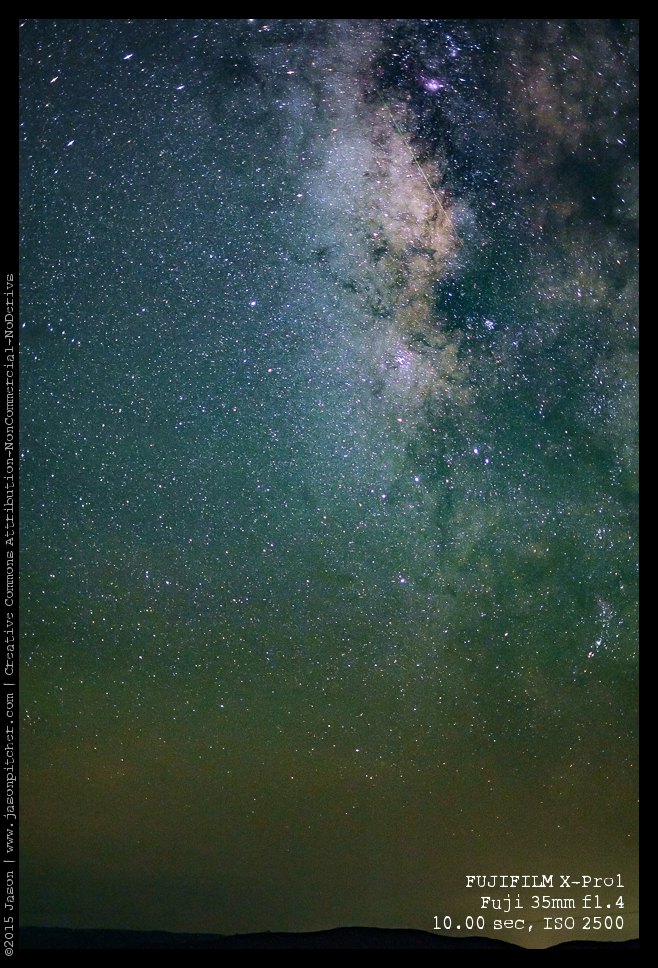
Fuji 35mm f1.4 (Rent from Borrowlenses) (Buy from Amazon)
The 35mm f1.4 surprised me by it’s poor performance. The astigmatism in the corners is very pronounced. I know this is an early lens design for the system, but it really bugs me when I see how bad the corners are. This image is the closest I got to getting the exposure “right” with the underexposure limited to about 1 stop, which has been corrected.
 So which lens is best? I’ll let you decide which one you prefer, but for me my personal favourite all round lens is the 18mm, and for astrophotography, the budget Rokinon is an excellent choice. I think my biggest challenge in the field was focusing. I’m not sure I nailed it with any of these images, but they do look pretty. As for the lenses, all of them are very capable. You certainly don’t need the speed of the 16, 23 or 35, although I’ll need to expose to the right and get better images to really appreciate the faster lenses. The astigmatism is noticeable on the 16mm, pronounced on the 35mm, still apparent on the 23, but that is the cost of speed and a better noise profile that comes with it.
At the end of the night, all of these lenses are capable of delivering, except the 35mm. I’m just not a fan of that lens. The angle of view I find too limiting and the quality of the optics at the edges are not where I’d expect it to be, i.e. much better. The center seems fine though and for most things it’s a “nifty fifty” equivalent, just not in this application.
One really important thing I learned is to make a note of the slowest shutter speed you can use for a given focal length and have it with you! I should have done a better job of nailing the exposure, but that comes with practice. This was my first attempt, and I knew I’d have lots of learning moments. I also suspect that I may have some camera vibration from wind, so next time I’ll break out the heavier tripod, if I’ve driven to the location, or shorten up the legs on the travel tripod for more stability.
I should also try some of the more advanced post processing that Ian talks about on his site, such as exposure stacking for noise reduction. Next time I’ll use a single focal length, get the composition nailed and just work the single lens to get a better handle on astrophotography. It would be easier if a dark sky was just a little bit closer to home.
More to come…
So which lens is best? I’ll let you decide which one you prefer, but for me my personal favourite all round lens is the 18mm, and for astrophotography, the budget Rokinon is an excellent choice. I think my biggest challenge in the field was focusing. I’m not sure I nailed it with any of these images, but they do look pretty. As for the lenses, all of them are very capable. You certainly don’t need the speed of the 16, 23 or 35, although I’ll need to expose to the right and get better images to really appreciate the faster lenses. The astigmatism is noticeable on the 16mm, pronounced on the 35mm, still apparent on the 23, but that is the cost of speed and a better noise profile that comes with it.
At the end of the night, all of these lenses are capable of delivering, except the 35mm. I’m just not a fan of that lens. The angle of view I find too limiting and the quality of the optics at the edges are not where I’d expect it to be, i.e. much better. The center seems fine though and for most things it’s a “nifty fifty” equivalent, just not in this application.
One really important thing I learned is to make a note of the slowest shutter speed you can use for a given focal length and have it with you! I should have done a better job of nailing the exposure, but that comes with practice. This was my first attempt, and I knew I’d have lots of learning moments. I also suspect that I may have some camera vibration from wind, so next time I’ll break out the heavier tripod, if I’ve driven to the location, or shorten up the legs on the travel tripod for more stability.
I should also try some of the more advanced post processing that Ian talks about on his site, such as exposure stacking for noise reduction. Next time I’ll use a single focal length, get the composition nailed and just work the single lens to get a better handle on astrophotography. It would be easier if a dark sky was just a little bit closer to home.
More to come…